

 English
 简体中文
简体中文 Русский
 Español
ZHEJIANG LUBA TRAFFIC TECHNOLOGY CO., LTD. * TRAFFIC SAFETY, WE LEAD EVERY STEP * ZHEJIANG LUBA TRAFFIC TECHNOLOGY CO., LTD. * TRAFFIC SAFETY, WE LEAD EVERY STEP * ZHEJIANG LUBA TRAFFIC TECHNOLOGY CO., LTD. * TRAFFIC SAFETY, WE LEAD EVERY STEP * ZHEJIANG LUBA TRAFFIC TECHNOLOGY CO., LTD.
What Challenges Do Cable Protector Manufacturers Face in Production
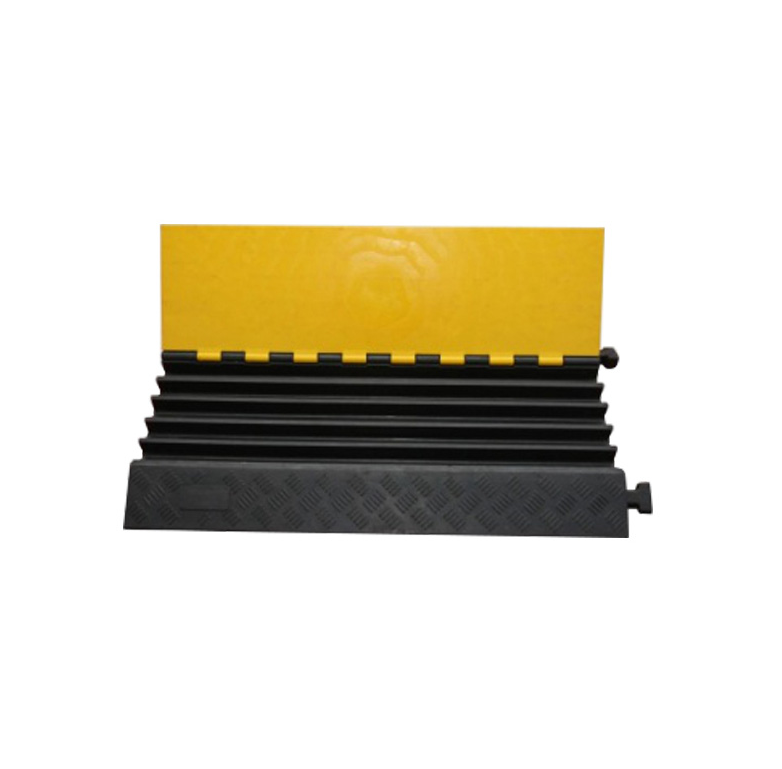
Cable protectors look straightforward when seen on job sites. A ramp shape, internal channels, a surface designed to handle repeated pressure. The product feels familiar in construction zones, event venues, and industrial floors. It is often treated as a standard item.
Inside Cable Protector Manufacturer , the situation is less simple. Production involves multiple linked steps where small changes can travel forward and affect final performance. Cable protector factories operate in a space where stability matters more than speed, and repeatability often matters more than design complexity.
The challenges are not always visible from the outside. They usually appear in details that only show up during long production cycles or real usage.
Why does material behavior create constant uncertainty?
Raw material is never perfectly uniform. Even when it comes from similar sources, its response during processing can shift slightly.
In cable protector manufacturing, this becomes noticeable during forming. Some batches feel more stable. Others respond differently under the same conditions.
This does not always cause failure, but it changes the way the product behaves later. A small shift in flexibility can affect how the ramp sits on the ground. A slight difference in hardness can influence how it reacts to repeated vehicle pressure.
Manufacturers often spend a lot of effort simply keeping material behavior predictable enough to work with. It is less about changing materials and more about reducing unexpected variation.
How does structural complexity appear in a simple product?
A cable protector may look like a basic ramp, but its internal structure carries more detail than expected.
Inside, there are channels that guide cables, support sections that carry weight, and connecting parts that allow multiple units to link together.
Each of these parts must align properly. If one section shifts even slightly during production, the whole piece may not fit well with others.
The challenge is not in making the shape once. It is in repeating the same shape consistently across many production cycles without drift.
Why is batch consistency difficult to control over time?
Manufacturing is rarely a single uninterrupted flow. It happens in cycles. Each cycle introduces small differences, even when conditions are controlled.
These differences may come from machine wear, material response, or minor environmental changes. They are often too small to notice immediately.
The issue appears later when different batches are used together. One section of a project may feel slightly different from another. Alignment may not be as smooth as expected.
For cable protector systems, this matters because products are often connected in long runs. Consistency is more important than individual performance.
Where production challenges appear most often
| Production Stage | Typical Challenge | What it affects in use |
|---|---|---|
| Material preparation | Variation in raw material response | Flexibility and surface behavior |
| Forming stage | Uneven shaping under pressure | Cable fit and surface stability |
| Cooling and settling | Small structural shifts | Long-term durability |
| Batch repetition | Slight output differences | Compatibility between units |
| Assembly and finishing | Alignment of connecting parts | Installation smoothness |
These issues do not appear in isolation. In practice, they overlap and influence each other during continuous production.
Why does mold stability influence long-term quality?
Molds define the shape of cable protectors. Every groove, edge, and connection point comes from this stage.
When molds are stable, production remains predictable. When molds begin to shift slightly over time, even if the change is small, the effect can spread across large quantities of products.
This is one of the quieter challenges in manufacturing. It does not appear suddenly. It builds gradually.
Manufacturers often treat mold condition as something that needs regular attention rather than a fixed setup.
How does production pressure affect consistency?
Demand can rise or shift quickly. When production speed increases, the margin for small adjustments becomes narrower.
Cable protectors require structural accuracy. Even minor deviations can affect how they sit on the ground or how well they connect in sequence.
Under pressure, production lines may still run smoothly, but fine control becomes harder to maintain. That is where small variations start to appear more frequently.
Balancing output and stability is a constant part of manufacturing decisions.
Why is environmental stability part of production control?
Factory conditions are not just background details. Temperature and airflow can influence how materials behave during shaping.
A slight change in environment can affect how a material settles or cools. These changes are not dramatic, but they can influence surface uniformity or internal alignment.
Over time, even small fluctuations can lead to visible differences between batches if not managed carefully.
Because of this, environmental control is part of maintaining consistency rather than just improving comfort in production spaces.
How do design adjustments create hidden production challenges?
A cable protector design may be modified for different use cases. A small change in channel size or surface pattern can seem minor from a design perspective.
In production, even small adjustments can require changes in how the product is formed or processed.
This creates a hidden challenge. Design flexibility is important, but frequent changes can disrupt established production rhythm.
Manufacturers often need to balance adaptability with stability, making sure that improvements do not interrupt repeatable output.
Why does surface quality matter more than it appears?
The surface of a cable protector is not only about appearance. It affects grip, stability, and interaction with passing vehicles or foot traffic.
If surface consistency varies, performance may also vary. One section may feel more stable than another. Another may wear differently over time.
This is why surface formation is closely tied to production control rather than just finishing work.
Small inconsistencies here often become noticeable only after real use.
How does testing reveal limitations in production systems?
Testing is usually done on selected samples instead of every unit. This helps maintain efficiency, but it also means not every variation is directly observed.
If production variation exists within a batch, testing may not always capture it fully.
This creates a gap between controlled evaluation and real-world use. In practice, products are often judged again during application, not just during inspection.
That feedback becomes part of how manufacturers refine processes over time.
Why do real applications expose differences that production does not show?
Cable protectors are used in environments where conditions are not controlled. Pressure varies. Movement changes. Installation surfaces are not always uniform.
These factors highlight small differences that may not be visible during production.
A product that behaves consistently in one setting may respond differently in another. Over time, these differences help manufacturers understand where production adjustments are needed.
Real-world use becomes an extension of quality observation.
What makes production challenges ongoing rather than fixed?
Cable protector manufacturing is not a process that reaches a final stable point and stops changing.
Material behavior shifts. Equipment gradually changes. Design updates appear. Usage environments evolve.
Each of these factors adds small variations over time.
The challenge is not solving a single issue, but maintaining balance across many small influences that continue to move.
ZHEJIANG LUBA TRAFFIC TECHNOLOGY CO., LTD. * TRAFFIC SAFETY, WE LEAD EVERY STEP * ZHEJIANG LUBA TRAFFIC TECHNOLOGY CO., LTD. * TRAFFIC SAFETY, WE LEAD EVERY STEP * ZHEJIANG LUBA TRAFFIC TECHNOLOGY CO., LTD. * TRAFFIC SAFETY, WE LEAD EVERY STEP * ZHEJIANG LUBA TRAFFIC TECHNOLOGY CO., LTD.
ZHEJIANG LUBA TRAFFIC TECHNOLOGY CO., LTD. * TRAFFIC SAFETY, WE LEAD EVERY STEP * ZHEJIANG LUBA TRAFFIC TECHNOLOGY CO., LTD. * TRAFFIC SAFETY, WE LEAD EVERY STEP * ZHEJIANG LUBA TRAFFIC TECHNOLOGY CO., LTD. * TRAFFIC SAFETY, WE LEAD EVERY STEP * ZHEJIANG LUBA TRAFFIC TECHNOLOGY CO., LTD.

Zhejiang Luba Traffic Technology Co., Ltd. has been dedicated to the R&D and production of rubber and plastic products in the traffic facilities field since its establishment in 2001.
- (+86) 15724246878
- [email protected]
- No.399 West Guangming Road, Sanmen, Taizhou, Zhejiang, China.
Contact us to get our latest product information.
Copyright © Zhejiang Luba Traffic Technology Co.,Ltd. Rights Reserved.

Rubber Speed Hump Supplier