

 English
 简体中文
 Русский
 Español

ZHEJIANG LUBA TRAFFIC TECHNOLOGY CO., LTD. * TRAFFIC SAFETY, WE LEAD EVERY STEP * ZHEJIANG LUBA TRAFFIC TECHNOLOGY CO., LTD. * TRAFFIC SAFETY, WE LEAD EVERY STEP * ZHEJIANG LUBA TRAFFIC TECHNOLOGY CO., LTD. * TRAFFIC SAFETY, WE LEAD EVERY STEP * ZHEJIANG LUBA TRAFFIC TECHNOLOGY CO., LTD.
Cable Protector Routes: How Should Sections Meet at a Turn?
A straight cable crossing is easy to sketch. A route that changes direction beside a booth, workshop entrance or temporary service area needs more thought. The individual protector may look suitable, while the completed route leaves a gap, a poorly seated joint or a cable bend that cannot fit inside the channel.
For purchasing teams, route planning should precede a count of straight sections. Start with the actual path and then ask which compatible pieces can form it. A drawing showing where each section goes is more useful than a quotation listing a quantity of ramps without explaining their arrangement.
Follow the cable path through the crossing
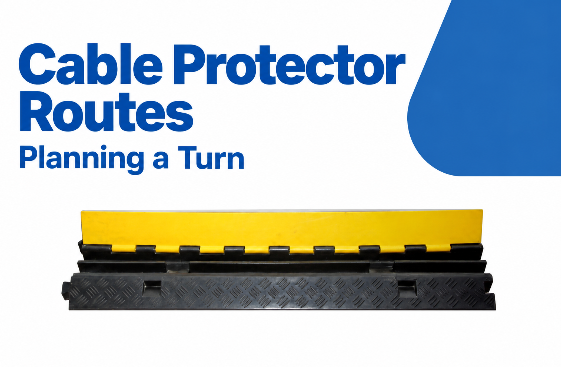
The two-channel cable protector provides a product reference for this discussion; confirm the exact ordered version and its supporting documents before applying the checklist.
Mark the cable's approach and exit, the crossing width and the direction of travel around it. Identify fixed obstacles, doors and areas that must remain accessible. The cable route and the movement route interact, so neither should be drawn in isolation.
At a turn, consider the cable bend inside the protector rather than only the outline of the ramp. The required bend radius depends on the cable and its instructions. Do not force a cable into a sharper curve simply because an angled arrangement looks compact on the floor plan.
Ask whether the sections are designed to connect
Joining profiles can vary between product families. Similar colours or channel counts do not establish compatibility. Ask the supplier to identify the straight, angled and end components available for the selected range and to confirm which pieces are intended to be used together.
If the range does not include a required turn, revise the layout with the responsible site team. Cutting a section, leaving connectors partly engaged or mixing unrelated products should not become an improvised substitute for a documented arrangement. The supplier should review any proposed modification before it is included in a purchase specification.
| Route feature | Detail to request | Site review point |
|---|---|---|
| Straight run | Section length and joint profile | Overall installed distance |
| Change of direction | Compatible turn arrangement | Cable bend and joint seating |
| Route end | Available end treatment | Cable entry and surrounding access |
| Multiple channels | Channel continuity through each piece | Correct cable separation and fit |
| Doorway crossing | Complete installed height and position | Door movement and clear route |
These details establish a layout discussion. They do not establish a traffic load rating or suitability for every public-access location. The project team must check the proposed arrangement against actual site use and applicable requirements.
Count usable installed length
A nominal section length may not equal the amount it adds to a connected run if joining features overlap. Ask for the installed length basis used in the quotation. This becomes particularly relevant where the route must finish at a defined position rather than somewhere within a broad open area.
Show the direction of every connector on the drawing. If the last piece must meet another run, the orientation can matter as much as the section count. A simple numbered layout also helps receiving staff confirm that the supplied parts form the intended arrangement.
- Identify every section by product code and position.
- Confirm which connectors mate along the proposed route.
- Record installed dimensions rather than adding catalogue lengths blindly.
- Check channel continuity with the actual cable arrangement.
- Review route ends and changes of direction before shipment.
Include any spare sections as a separate line. Otherwise a receiving team may interpret a spare as an extra piece intended for the installed route. The distinction also makes future maintenance orders easier: the replacement part can be matched to an identified position.
Review the arrangement on the real surface
A protector resting on an uneven surface can behave differently from one shown on a flat catalogue background. Survey the crossing and identify local steps, gaps or loose material. Ask the site team to assess whether the selected product and any specified fixing method suit that surface.
Consider movement during use. If sections are repeatedly shifted or lifted for access, plan how they will be returned to their correct positions. A joint that was properly seated during initial installation still needs to remain properly seated when the route is put back into service.
The layout should also account for inspection. Staff need a practical way to check for damaged sections, displaced joints and cables that prevent lids from closing. Keep these observations within the site's maintenance routine rather than assuming that a connected route requires no further attention.
Build an order that can be checked
Attach the approved route drawing to the order. List straight sections, any compatible directional pieces and any agreed accessories separately. Ask for confirmation of the selected product range so that a later stock substitution does not silently change the joining profile.
At receiving, lay out representative connected pieces before distributing the shipment around the site. Confirm connector engagement, lid closure and the intended route sequence without treating that visual review as a proof of rated traffic performance. Where performance evidence is required, retain the relevant supplier documents for the exact supplied product.
The goal is a route that has been considered as a complete system of pieces and interfaces. A careful section schedule cannot replace a site assessment, but it can prevent a basic purchasing problem: receiving a collection of individually plausible ramps that do not form the crossing the project actually needs.
ZHEJIANG LUBA TRAFFIC TECHNOLOGY CO., LTD. * TRAFFIC SAFETY, WE LEAD EVERY STEP * ZHEJIANG LUBA TRAFFIC TECHNOLOGY CO., LTD. * TRAFFIC SAFETY, WE LEAD EVERY STEP * ZHEJIANG LUBA TRAFFIC TECHNOLOGY CO., LTD. * TRAFFIC SAFETY, WE LEAD EVERY STEP * ZHEJIANG LUBA TRAFFIC TECHNOLOGY CO., LTD.
ZHEJIANG LUBA TRAFFIC TECHNOLOGY CO., LTD. * TRAFFIC SAFETY, WE LEAD EVERY STEP * ZHEJIANG LUBA TRAFFIC TECHNOLOGY CO., LTD. * TRAFFIC SAFETY, WE LEAD EVERY STEP * ZHEJIANG LUBA TRAFFIC TECHNOLOGY CO., LTD. * TRAFFIC SAFETY, WE LEAD EVERY STEP * ZHEJIANG LUBA TRAFFIC TECHNOLOGY CO., LTD.

Zhejiang Luba Traffic Technology Co., Ltd. has been dedicated to the R&D and production of rubber and plastic products in the traffic facilities field since its establishment in 2001.
- (+86) 15724246878
- [email protected]
- No.399 West Guangming Road, Sanmen, Taizhou, Zhejiang, China.
Contact us to get our latest product information.
Copyright © Zhejiang Luba Traffic Technology Co.,Ltd. Rights Reserved.

Rubber Speed Hump Supplier