

 English
 简体中文
 Русский
 Español

ZHEJIANG LUBA TRAFFIC TECHNOLOGY CO., LTD. * TRAFFIC SAFETY, WE LEAD EVERY STEP * ZHEJIANG LUBA TRAFFIC TECHNOLOGY CO., LTD. * TRAFFIC SAFETY, WE LEAD EVERY STEP * ZHEJIANG LUBA TRAFFIC TECHNOLOGY CO., LTD. * TRAFFIC SAFETY, WE LEAD EVERY STEP * ZHEJIANG LUBA TRAFFIC TECHNOLOGY CO., LTD.
Plan a Three-Channel Cable Crossing Before the Event Opens
The last cable across an event route often creates a larger planning problem than its diameter suggests. A temporary power or signal line needs protection, but the crossing also changes the surface used by pedestrians, trolleys and vehicles. Choosing the cable cover is therefore part of route design, rather than a final accessory purchase after the floor plan is fixed.
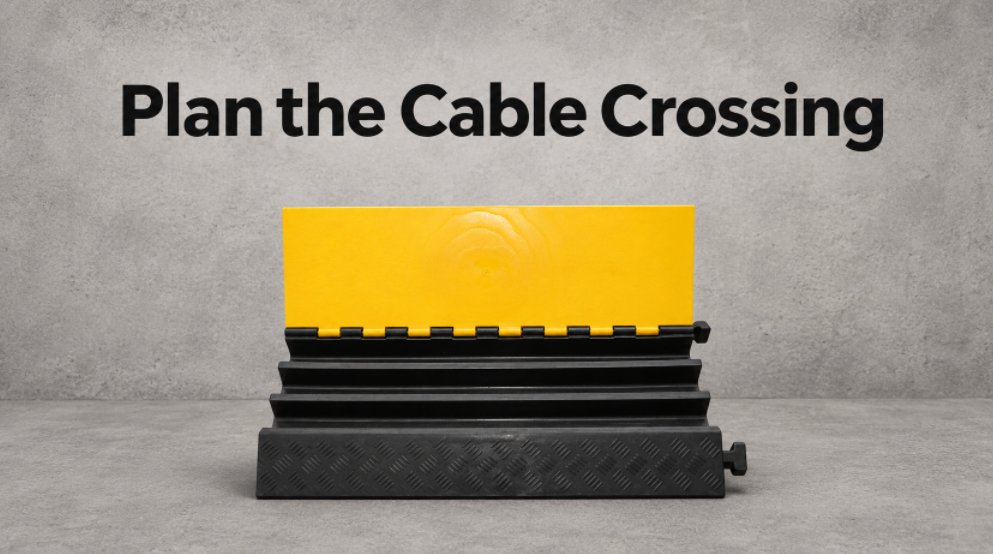
LUBA's three-channel road safety rubber cable protection cover has a black body and a yellow opening lid. Its separated internal channels provide a practical reference for organizing a crossing. Before ordering, establish what must fit inside those channels, what must travel across the cover and who will inspect the installation during the event.
Walk the route before counting modules
Start with the actual route between the equipment and its supply or connection point. Mark doors, changes in level, drainage paths and locations where traffic turns. A straight crossing on a stable surface is easier to evaluate than one placed diagonally through a busy corner. The shortest cable route is not always the most suitable route for the people using the site.
Identify who controls the area. The event organizer, venue operator, electrical contractor and traffic team may have different responsibilities. Agree who approves the position and who can close the crossing if a module moves or becomes damaged. That decision should be made before cables are laid, when moving the route is still straightforward.
Do not assume that a cable protector creates an accessible route by itself. Its profile introduces a change in level. Review pedestrian movement, wheeled access and any alternative route with the responsible site team. Keep emergency routes and doors subject to the venue's approval requirements.
Measure the cable bundle, then check the channel
A three-channel description tells the buyer how many separate spaces the product provides. It does not establish that a particular connector, hose or bundle will fit. Obtain the usable channel dimensions and compare them with the largest outside dimensions of the proposed contents. Allow for the actual cable arrangement rather than dividing total cable area by the number of channels.
Connectors may be wider than the cable they serve. They may also require access for inspection or disconnection. Locate them deliberately instead of forcing them beneath a lid. Cables should lie without being pinched, sharply bent or compressed when the cover closes. Electrical separation, grouping and heat considerations should be assessed by the responsible contractor.
| Route condition | Check before purchase | Site decision |
|---|---|---|
| Mixed cable sizes | Usable channel width and depth | Assign contents to channels without overcrowding |
| Trolley movement | Wheel behavior over the actual profile | Approve the route with representative equipment |
| Vehicle crossing | Applicable product load information | Match traffic and installation conditions |
| Outdoor exposure | Surface stability and water path | Prevent movement and inspect after weather changes |
| Long crossing | Module length and joint arrangement | Keep the assembly continuous and aligned |
Load claims need a defined context
Vehicle type alone does not provide a complete load specification. Wheel load, tyre contact, speed, turning and the supporting surface can affect the crossing. Ask for the relevant rating and conditions for the exact product. Do not turn an unspecified “heavy duty” description into a numerical capacity or an unrestricted forklift approval.
The same care applies to a temporary outdoor route. Water-resistant materials do not establish the electrical suitability of submerged cables or connections. Surface drainage and electrical protection remain separate design questions. Confirm how the installation will be checked after rain, cleaning or changes in the event layout.
Build a repeatable setup routine
- Clear and inspect the supporting surface before placing modules.
- Lay out the full route and check the joints before loading cables.
- Place the approved cables in their assigned channels without forcing bends.
- Close the lids and inspect the full length for trapped material or gaps.
- Check the crossing with the site team before admitting normal traffic.
- Record inspection responsibility and a method for isolating a damaged section.
The yellow lid provides visual contrast with the black body, but visibility should be reviewed under the venue's actual lighting. Crowds, equipment cases and temporary signs can obscure a crossing. Keep the approach clear and use the site's traffic management arrangements where needed. Do not rely on product color to replace route supervision.
During operation, inspect for displaced modules, open lids, debris and exposed cable. Changes to the equipment layout can introduce new cable sizes or connections after the initial approval. Treat those changes as a reason to reopen the route assessment. A cover that was correctly loaded at setup may no longer be suitable after another contractor adds a cable.
Include packing and replacement needs in the order
For a rental fleet or repeated event program, identify modules by product version and keep replacement components compatible. Ask how the lid and body are supplied and whether any accessories are included. Plan storage so that modules can be inspected before the next installation instead of discovering damage at the venue.
A useful LUBA enquiry includes the required crossing length, cable dimensions, traffic description, surface conditions and expected deployment pattern. Those details support a more meaningful product discussion than quantity alone. The objective is a complete, inspectable cable crossing whose route and contents have both been considered before the event opens.
For repeated deployments, keep a simple route sketch with the event equipment list. Mark the number of modules, the direction of the crossing and the cable assignment. The next crew can use that record as a starting point, then check it against current conditions. A sketch is especially helpful when equipment moves between rehearsal and public opening, because the person inspecting the crossing can see whether the approved layout still matches the installed route.
ZHEJIANG LUBA TRAFFIC TECHNOLOGY CO., LTD. * TRAFFIC SAFETY, WE LEAD EVERY STEP * ZHEJIANG LUBA TRAFFIC TECHNOLOGY CO., LTD. * TRAFFIC SAFETY, WE LEAD EVERY STEP * ZHEJIANG LUBA TRAFFIC TECHNOLOGY CO., LTD. * TRAFFIC SAFETY, WE LEAD EVERY STEP * ZHEJIANG LUBA TRAFFIC TECHNOLOGY CO., LTD.
ZHEJIANG LUBA TRAFFIC TECHNOLOGY CO., LTD. * TRAFFIC SAFETY, WE LEAD EVERY STEP * ZHEJIANG LUBA TRAFFIC TECHNOLOGY CO., LTD. * TRAFFIC SAFETY, WE LEAD EVERY STEP * ZHEJIANG LUBA TRAFFIC TECHNOLOGY CO., LTD. * TRAFFIC SAFETY, WE LEAD EVERY STEP * ZHEJIANG LUBA TRAFFIC TECHNOLOGY CO., LTD.

Zhejiang Luba Traffic Technology Co., Ltd. has been dedicated to the R&D and production of rubber and plastic products in the traffic facilities field since its establishment in 2001.
- (+86) 15724246878
- [email protected]
- No.399 West Guangming Road, Sanmen, Taizhou, Zhejiang, China.
Contact us to get our latest product information.
Copyright © Zhejiang Luba Traffic Technology Co.,Ltd. Rights Reserved.

Rubber Speed Hump Supplier