

 English
 简体中文
 Русский
 Español

ZHEJIANG LUBA TRAFFIC TECHNOLOGY CO., LTD. * TRAFFIC SAFETY, WE LEAD EVERY STEP * ZHEJIANG LUBA TRAFFIC TECHNOLOGY CO., LTD. * TRAFFIC SAFETY, WE LEAD EVERY STEP * ZHEJIANG LUBA TRAFFIC TECHNOLOGY CO., LTD. * TRAFFIC SAFETY, WE LEAD EVERY STEP * ZHEJIANG LUBA TRAFFIC TECHNOLOGY CO., LTD.
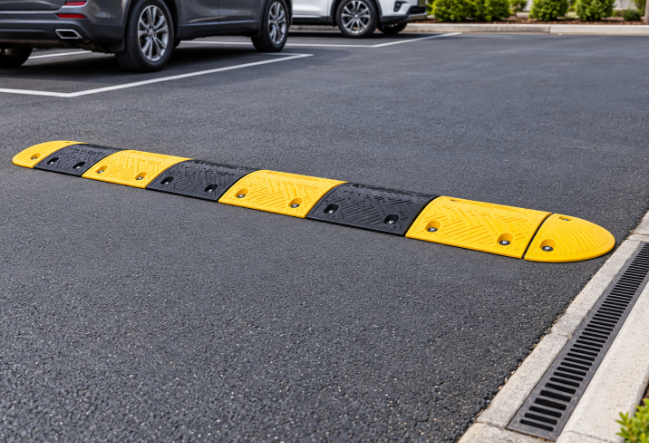
Rubber Speed Humps: Review the Profile and Drainage Together
The height of a rubber speed hump is only one part of its geometry. The distance over which a vehicle rises and descends, the end sections and the surrounding pavement all influence how the installation fits a site. Buyers comparing products for private parking areas or access roads should review the complete profile before choosing a modular system.
Speed hump drainage belongs in the same discussion. An installation that interrupts a water path may create a maintenance issue that was invisible in the catalogue image. A useful specification connects the product dimensions with the vehicle types, pavement and drainage arrangement actually present at the site.
Identify the location and permitted treatment
Begin with the purpose of the proposed installation: slowing vehicles near a private entrance, managing movement within a parking area or another defined site function. Establish who approves the traffic arrangement and which local requirements apply before selecting a product.
Do not assume that a modular parking product is suitable for any public roadway. Roadway treatments, signs and markings require the relevant authority's design and approval process. A manufacturer's general product description cannot replace that decision.
For procurement, keep a site plan showing the proposed location and adjacent pedestrian routes. Mark gates, loading areas and vehicle turning paths. This gives the site reviewer more context than an isolated request for a certain length of black and yellow sections.
Compare the longitudinal profile
When reviewing rubber speed humps, ask for a cross section in the direction of vehicle travel. Identify the height, overall travel length and shape of the rising and falling surfaces. Products with the same height can present different profiles and should not automatically be considered equivalent.
Use the selected model drawing rather than scaling a photograph. If a project specification names a profile, compare the complete drawing with that requirement. Do not substitute a shorter or differently shaped section solely because its maximum height matches.
Check the vehicle mix and clearance conditions
List the vehicles expected to cross the treatment, including delivery vans, loaded service vehicles and any low clearance passenger cars relevant to the site. Ground clearance, wheelbase and loading conditions can affect the review of a vertical change in the pavement.
An illustrative project might have passenger cars at the entrance and pallet delivery vehicles using the same access. The purchasing decision should consider both groups. A sample crossing by one empty vehicle cannot establish suitability for the entire fleet.
Ask the site designer to assess the selected profile against the intended vehicles and traffic arrangement. The product's material or stated load capacity does not answer every clearance question. Keep the traffic function and the mechanical support requirement as separate checks.
Follow the existing water path
Survey where surface water flows before installation. Note gutter lines, pavement crossfall and nearby drains. A modular section crossing the aisle may form an obstruction if its position and ends are chosen without regard to that flow.
Photographs after rain can support the survey, but they do not replace levels or drainage design where needed. Record standing water that already exists so it is not mistakenly attributed to the new product or overlooked during planning.
Review the modular joints and end sections
A complete row may contain centre modules and shaped ends. Confirm how the components join and how their combined dimensions establish the finished width. Count the actual parts required instead of dividing the aisle width by a rounded catalogue module length.
Examine the edges that vehicles, pedestrians or maintenance equipment may approach. The end arrangement should follow the selected product and site design. Avoid leaving an unfinished edge because a quotation included only centre sections.
Record the agreed colour sequence and visible surface features without treating colour alone as a complete warning system. Any required signs and markings are a separate site design matter. The product order should identify the rubber components while the approved plan identifies the full traffic arrangement.
Match fixing details to the pavement
Installation involves the product, fasteners and supporting surface. Establish whether the pavement is asphalt, concrete or another construction, and obtain the manufacturer's applicable fixing guidance. An anchor intended for one substrate should not be assumed suitable for another.
Check the pavement condition and any buried service constraints before work is planned. A damaged or unsuitable surface needs site attention; adding more fixings is not an evidence based substitute for reviewing the support.
For a bulk purchase, specify whether fixing hardware is included and identify it by type. Keep the installation instruction revision with the order. The receiving team should be able to distinguish a complete installation set from a shipment of loose modules.
Plan inspection and replacement access
The site operator needs a way to inspect fixings, joints and visible damage after installation. Establish the review responsibility and use the supplier's maintenance guidance. Where a damaged module can be replaced, keep the correct replacement code and component orientation in the site record.
Consider how sweeping, snow removal where relevant and other pavement maintenance will interact with the treatment. These are practical operating conditions to raise during product selection, not reasons to invent durability promises unsupported by product evidence.
A sound purchase brief includes the speed hump profile, vehicle mix, site layout, drainage path and fixing arrangement. That combination helps the buyer order the correct parts and gives the installer a defined basis for the work, while leaving traffic design and approval with the responsible site professionals.
ZHEJIANG LUBA TRAFFIC TECHNOLOGY CO., LTD. * TRAFFIC SAFETY, WE LEAD EVERY STEP * ZHEJIANG LUBA TRAFFIC TECHNOLOGY CO., LTD. * TRAFFIC SAFETY, WE LEAD EVERY STEP * ZHEJIANG LUBA TRAFFIC TECHNOLOGY CO., LTD. * TRAFFIC SAFETY, WE LEAD EVERY STEP * ZHEJIANG LUBA TRAFFIC TECHNOLOGY CO., LTD.
ZHEJIANG LUBA TRAFFIC TECHNOLOGY CO., LTD. * TRAFFIC SAFETY, WE LEAD EVERY STEP * ZHEJIANG LUBA TRAFFIC TECHNOLOGY CO., LTD. * TRAFFIC SAFETY, WE LEAD EVERY STEP * ZHEJIANG LUBA TRAFFIC TECHNOLOGY CO., LTD. * TRAFFIC SAFETY, WE LEAD EVERY STEP * ZHEJIANG LUBA TRAFFIC TECHNOLOGY CO., LTD.

Zhejiang Luba Traffic Technology Co., Ltd. has been dedicated to the R&D and production of rubber and plastic products in the traffic facilities field since its establishment in 2001.
- (+86) 15724246878
- [email protected]
- No.399 West Guangming Road, Sanmen, Taizhou, Zhejiang, China.
Contact us to get our latest product information.
Copyright © Zhejiang Luba Traffic Technology Co.,Ltd. Rights Reserved.

Rubber Speed Hump Supplier