

 English
 简体中文
 Русский
 Español

ZHEJIANG LUBA TRAFFIC TECHNOLOGY CO., LTD. * TRAFFIC SAFETY, WE LEAD EVERY STEP * ZHEJIANG LUBA TRAFFIC TECHNOLOGY CO., LTD. * TRAFFIC SAFETY, WE LEAD EVERY STEP * ZHEJIANG LUBA TRAFFIC TECHNOLOGY CO., LTD. * TRAFFIC SAFETY, WE LEAD EVERY STEP * ZHEJIANG LUBA TRAFFIC TECHNOLOGY CO., LTD.
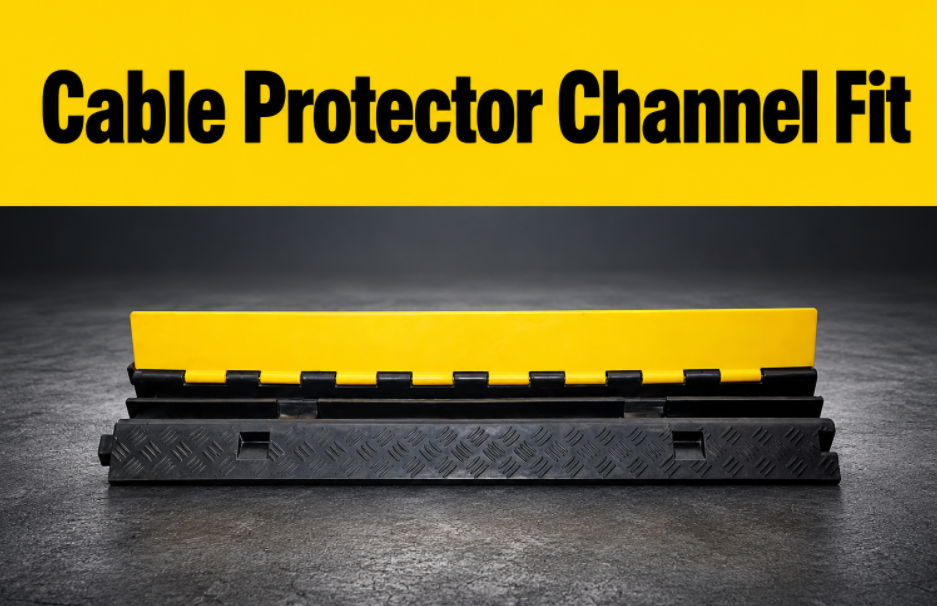
Will the Cable Fit Inside the Protector with the Lid Closed?
At a temporary event or a working site, the cable route is often planned before the exact cable protector is selected. That sequence can leave an awkward discovery: the cable fits in the open trough, but a connector prevents the lid from closing. Cable protector channel fit needs to be checked with the complete route and the actual items passing through it.
The buyer's task is to match the protector to an approved cable-management plan. Channel count, outer ramp dimensions and a headline load figure each describe something useful, but none alone proves that the intended arrangement is suitable. The site team needs a defined configuration to review.
The outside ramp size does not describe the channel
A two-channel cable protector has an external footprint and internal spaces with different purposes. Use the product drawing to identify the usable channel dimensions. Do not estimate them from the overall width or from the appearance of a black-and-yellow product photograph.
Check how the supplier defines channel width and height. A dimensioned cross-section is more useful than a general description such as heavy duty. It should allow the buyer to identify the space available when the lid is in its normal closed position.
Confirm the exact model and version before comparing drawings. Related protectors may have similar external styling but different internal geometry. Keep the channel reference beside the order so the warehouse does not substitute another ramp solely because its outer dimensions appear close.
Cable diameter is only the starting point
Record the actual outside diameter of each cable or approved bundle. Then identify connectors, couplers or protective sleeves that may need to pass through the route. The largest local feature can govern fit even when the main cable length appears comfortably smaller than the channel.
Do not assume a connector may sit inside the protector. Ask the responsible site team to define the permitted arrangement and provide it for supplier review. Electrical suitability, segregation and heat-related requirements remain part of the cable-system assessment, not something established by mechanical fit.
Where a hose is proposed instead of a cable, describe it accurately. A channel that accommodates its outside diameter does not automatically establish suitability under pressure, movement or the intended traffic. Obtain application-specific confirmation rather than treating every flexible line as equivalent.
Review closed-lid cable clearance
Closed-lid cable clearance is the condition that matters for the intended protected crossing. Ask how the selected cable arrangement sits in the channel with the cover closed according to the product instructions. Do not force the lid or use an improvised spacer to make an unsuitable arrangement appear complete.
Check entry and exit points as well as the middle of the run. A cable may fit a straight section yet encounter an unsuitable bend or abrupt change where it leaves the protector. The site layout should include the full route, with cable-handling limits assessed by the responsible personnel.
For several cables, do not add their cross-sectional areas and assume the total proves fit. Their physical arrangement, channel shape and project segregation requirements all matter. Use an actual proposed layout or an agreed sample review to close the question.
Make the cable ramp channel size record useful
| Route item | Information to provide | Fit question |
|---|---|---|
| Cable body | Actual outside diameter and quantity | Does the proposed arrangement occupy the available space? |
| Local enlargements | Connectors, sleeves or couplers | Is the whole route compatible? |
| Protector section | Model and closed-lid channel drawing | Which usable geometry is offered? |
| Entry and exit | Direction and required cable handling | Can the line follow the intended route? |
| Section joints | Approved connection arrangement | Is the channel continuous as intended? |
| Use conditions | Traffic, surface and project restrictions | What additional assessment is required? |
This record prevents a familiar purchasing ambiguity: several protectors described by the same channel count while their usable spaces differ. Keep the drawings and supplied version connected to the quotation.
Fit and traffic capacity are different approvals
A cable fitting inside a channel does not establish a safe traffic crossing. Provide the expected vehicles, contact conditions and site use for review. Any required load evidence should identify the product configuration and test conditions relevant to the project.
Avoid converting a catalogue maximum into a universal statement about every vehicle or surface. The responsible site team should assess the actual route, support conditions and applicable requirements. If a quoted figure is unclear, request its basis before using it in a purchasing comparison.
Pedestrian routes need their own consideration. Visibility, transitions and accessibility cannot be settled by cable diameter alone. Keep these issues with the overall site plan rather than treating a fitting cable as the end of the selection process.
Try the proposed combination before ordering the full run
Where fit is uncertain, review a representative protector and the actual intended cable arrangement under an approved procedure. Record the model, cable references and observations. A demonstration with a smaller substitute cable does not close the original question.
Confirm how sections connect and whether any accessories are included. Count the complete route rather than ordering only enough middle pieces to match a rough distance. Keep optional items and spares separate from the installed quantity.
- Obtain the current closed-lid channel drawing.
- Record cables and every local enlargement along the route.
- Review entries, exits and joins with the site team.
- Keep mechanical fit separate from electrical and traffic approval.
- Evaluate an actual representative combination where needed.
- Order the confirmed model and complete route contents.
A clear fit review turns a general request for cable ramps into a specific application enquiry. Send the cable schedule and route drawing together so that usable channel space, product scope and site requirements can be assessed before the crossing is assembled.
ZHEJIANG LUBA TRAFFIC TECHNOLOGY CO., LTD. * TRAFFIC SAFETY, WE LEAD EVERY STEP * ZHEJIANG LUBA TRAFFIC TECHNOLOGY CO., LTD. * TRAFFIC SAFETY, WE LEAD EVERY STEP * ZHEJIANG LUBA TRAFFIC TECHNOLOGY CO., LTD. * TRAFFIC SAFETY, WE LEAD EVERY STEP * ZHEJIANG LUBA TRAFFIC TECHNOLOGY CO., LTD.
ZHEJIANG LUBA TRAFFIC TECHNOLOGY CO., LTD. * TRAFFIC SAFETY, WE LEAD EVERY STEP * ZHEJIANG LUBA TRAFFIC TECHNOLOGY CO., LTD. * TRAFFIC SAFETY, WE LEAD EVERY STEP * ZHEJIANG LUBA TRAFFIC TECHNOLOGY CO., LTD. * TRAFFIC SAFETY, WE LEAD EVERY STEP * ZHEJIANG LUBA TRAFFIC TECHNOLOGY CO., LTD.

Zhejiang Luba Traffic Technology Co., Ltd. has been dedicated to the R&D and production of rubber and plastic products in the traffic facilities field since its establishment in 2001.
- (+86) 15724246878
- [email protected]
- No.399 West Guangming Road, Sanmen, Taizhou, Zhejiang, China.
Contact us to get our latest product information.
Copyright © Zhejiang Luba Traffic Technology Co.,Ltd. Rights Reserved.

Rubber Speed Hump Supplier