

 English
 简体中文
 Русский
 Español

ZHEJIANG LUBA TRAFFIC TECHNOLOGY CO., LTD. * TRAFFIC SAFETY, WE LEAD EVERY STEP * ZHEJIANG LUBA TRAFFIC TECHNOLOGY CO., LTD. * TRAFFIC SAFETY, WE LEAD EVERY STEP * ZHEJIANG LUBA TRAFFIC TECHNOLOGY CO., LTD. * TRAFFIC SAFETY, WE LEAD EVERY STEP * ZHEJIANG LUBA TRAFFIC TECHNOLOGY CO., LTD.
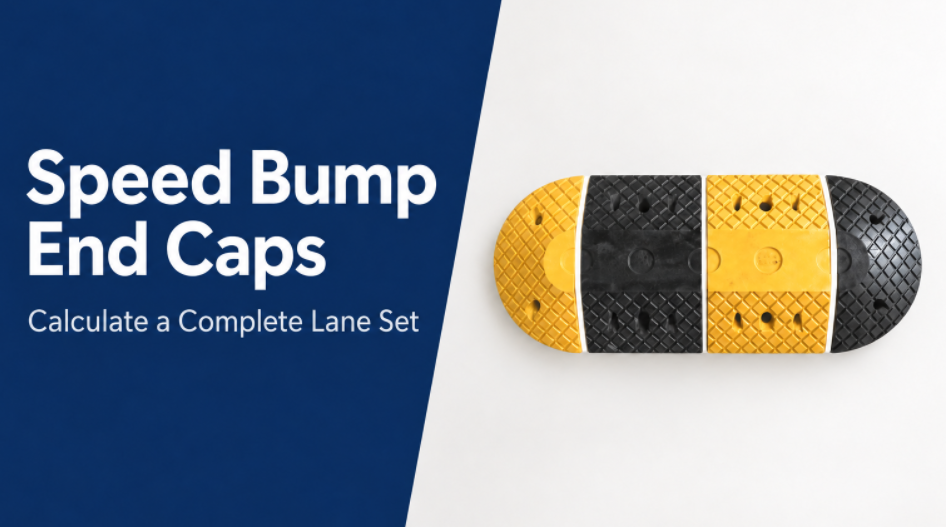
Speed Bump End Caps: Quote the Complete Installed Width
A modular rubber speed hump quotation can look complete while covering only the straight middle sections. Speed bump end caps, fixing items and the finished arrangement need to be identified separately. Otherwise, a price per piece can conceal a different supply scope from the lane set the buyer intends to install.
For parking operators, contractors and traffic-product distributors, the useful starting point is an approved site layout and a model-specific component schedule. This article concerns quantity and quotation planning. The site's responsible designer still needs to assess whether the proposed traffic measure, position and profile are appropriate and permitted.
Work from the lane layout
Identify the section family before counting pieces
Review the rubber speed hump range and choose the section family under consideration. Record the middle-section model and the matching end-cap references. Similar colours do not establish that components share the same profile, joint geometry or fixing layout.
Ask the supplier for the current dimensioned drawing of the complete arrangement. Product names may use length and width differently, so label the dimension that runs across the lane and the dimension that runs in the direction of vehicle travel. A marked plan view avoids relying on terminology alone.
Do not combine components from separate models simply to reach an approximate width. Their heights, transitions and connection details may differ. Any proposed combination should be reviewed by the supplier and the responsible site team before it is included in an order.
Define speed bump installed width on the layout
Speed bump installed width should refer to the finished assembly across the intended part of the lane, including its end treatment. State the required arrangement on a drawing rather than ordering enough centre pieces to equal a nominal roadway measurement.
The site layout should show the relevant boundaries and required clearances. Those requirements come from the responsible design and applicable site rules, not from a universal gap value. Confirm the intended termination at each side before converting the layout into product quantities.
Where section joints overlap or otherwise affect the finished dimension, use the manufacturer's assembly drawing. Adding standalone component dimensions may not equal the installed result. Ask the supplier to confirm the completed width for the proposed number of middle sections and end pieces.
Count middle sections and ends separately
Prepare a bill of materials for one complete location. List each type of middle section, the left and right end arrangements where relevant, and any specified accessories. If both ends use the same component, record the required quantity rather than assuming it is included with the centre sections.
Then multiply the approved location schedule by the number of identical installations. Keep locations with different widths on separate lines. A single total metre quantity can hide the number of separate runs, and each run may require its own end treatment.
For example, two separate lane assemblies need their end arrangements considered independently even if their combined centre-section length matches one longer assembly. This is a counting principle, not a proposed site design or a statement that every product uses the same two-cap configuration.
Reconcile the quotation with the complete set
Compare quotation scope consistently
| Quotation item | What to state | What to check |
|---|---|---|
| Middle section | Model and quantity per location | Correct section family |
| End treatment | Matching references and quantities | Included or separately priced |
| Finished width | Dimensioned complete assembly | Consistent measurement basis |
| Fixing scope | Supplier-specified items and quantities | Included, optional or site supplied |
| Packing | Contents and identification by component | Receiving completeness |
| Spare stock | Separate approved quantities | Excluded from installed totals |
Ask whether the quoted unit is a middle section, an end cap, a complete set or a defined length of assembled product. Keep freight and packing comparisons on the same contents basis. A lower unit price does not establish a lower cost for the complete required arrangement.
Check fixing information without inventing a site solution
Obtain the manufacturer's fixing guidance and the relevant component drawings. The substrate, site condition and project requirements should be reviewed by the responsible installer or designer. Do not prescribe one anchor type, embedment or spacing for every pavement.
Confirm which fixing items the supplier includes and whether the selection depends on the substrate. A photograph showing fixing holes does not establish that suitable fixings are supplied. Record the approved scope explicitly in the order and keep site-supplied items visible in the installation plan.
If the site has unusual drainage, service routes or surface conditions, provide that information for review. Quantity planning should follow the accepted layout. It should not bypass unresolved questions about where or how the assembly may be installed.
Keep the delivered quantities traceable
Inspect the complete component set on arrival
Receiving checks should compare the delivered middle sections and end pieces with the bill of materials. Check model identification, visible condition and quantities before sending mixed stock to multiple sites. An apparent surplus of one colour may be a shortage of another required component.
Keep packaging information that identifies component versions and lots where supplied. If parts do not match the approved drawing, resolve the difference before attempting an improvised fit. Cutting or modifying an end piece to make a different model fit should not become an undocumented substitution.
Agree any spare-stock quantities separately. Spares may be useful for later replacement, but they should not be counted as installed coverage. Retaining matching model references helps maintenance teams request the correct part when a location needs attention.
Keep rubber speed hump quantities traceable
- Use a labelled site layout with the intended finished width.
- Select matching middle sections and end components.
- Confirm the assembled dimension through the supplier drawing.
- Calculate each location before combining order totals.
- Separate fixings, packing and spare stock in the quotation.
- Retain the approved model schedule for receiving and service.
Clear rubber speed hump quantities turn a general metre requirement into an identifiable order. Send the lane schedule and proposed component family with the enquiry so that the supplier can quote complete arrangements and the site team can check them against the approved layout.
ZHEJIANG LUBA TRAFFIC TECHNOLOGY CO., LTD. * TRAFFIC SAFETY, WE LEAD EVERY STEP * ZHEJIANG LUBA TRAFFIC TECHNOLOGY CO., LTD. * TRAFFIC SAFETY, WE LEAD EVERY STEP * ZHEJIANG LUBA TRAFFIC TECHNOLOGY CO., LTD. * TRAFFIC SAFETY, WE LEAD EVERY STEP * ZHEJIANG LUBA TRAFFIC TECHNOLOGY CO., LTD.
ZHEJIANG LUBA TRAFFIC TECHNOLOGY CO., LTD. * TRAFFIC SAFETY, WE LEAD EVERY STEP * ZHEJIANG LUBA TRAFFIC TECHNOLOGY CO., LTD. * TRAFFIC SAFETY, WE LEAD EVERY STEP * ZHEJIANG LUBA TRAFFIC TECHNOLOGY CO., LTD. * TRAFFIC SAFETY, WE LEAD EVERY STEP * ZHEJIANG LUBA TRAFFIC TECHNOLOGY CO., LTD.

Zhejiang Luba Traffic Technology Co., Ltd. has been dedicated to the R&D and production of rubber and plastic products in the traffic facilities field since its establishment in 2001.
- (+86) 15724246878
- [email protected]
- No.399 West Guangming Road, Sanmen, Taizhou, Zhejiang, China.
Contact us to get our latest product information.
Copyright © Zhejiang Luba Traffic Technology Co.,Ltd. Rights Reserved.

Rubber Speed Hump Supplier