

 English
 简体中文
 Русский
 Español

ZHEJIANG LUBA TRAFFIC TECHNOLOGY CO., LTD. * TRAFFIC SAFETY, WE LEAD EVERY STEP * ZHEJIANG LUBA TRAFFIC TECHNOLOGY CO., LTD. * TRAFFIC SAFETY, WE LEAD EVERY STEP * ZHEJIANG LUBA TRAFFIC TECHNOLOGY CO., LTD. * TRAFFIC SAFETY, WE LEAD EVERY STEP * ZHEJIANG LUBA TRAFFIC TECHNOLOGY CO., LTD.
Wheel Stop Placement: Measure the Vehicle Overhang, Not Just the Bay
A parking bay can be long enough for a vehicle and still allow its body to overhang a walkway. The wheels stop before the bumper does. That simple geometry is the reason a wheel stopper should be positioned from the intended vehicle and site layout, rather than from the painted line alone.
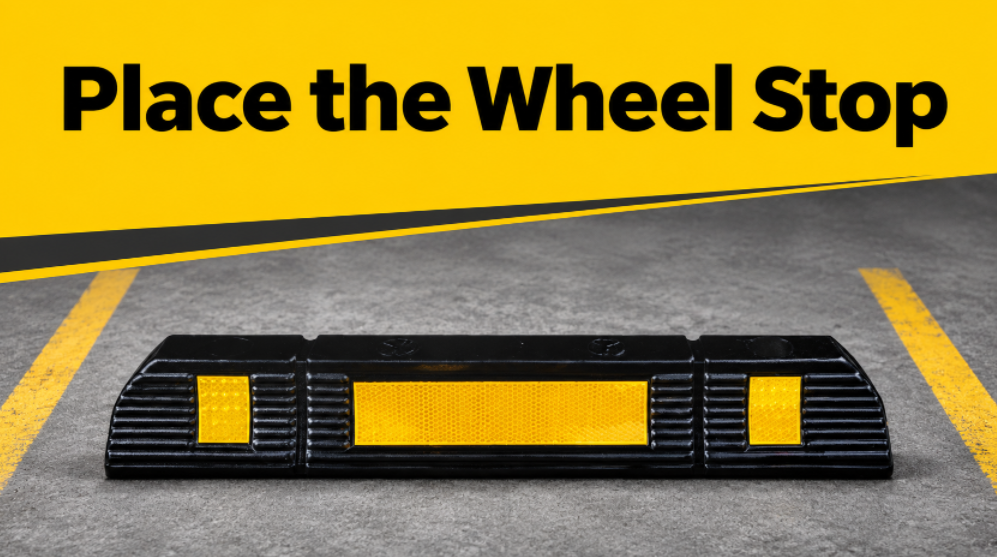
LUBA's WS-04 rubber car wheel stopper provides a specific product for the discussion. The black body and yellow visibility panels are useful visual features, but the product length or appearance does not determine where it belongs in every parking space. Position, fixing and accessibility need to be reviewed as parts of the same site arrangement.
Begin at the boundary that needs protection
Identify the wall, pedestrian route, planting area or equipment the site intends to keep clear. Then consider the front or rear overhang of the vehicles expected to park there. The tyre contact position and the furthest projecting bodywork are different reference points.
A single vehicle demonstration may help explain the geometry but should not define the whole site if several vehicle types use it. Low front bumpers, different wheelbases and varying overhangs can change the relationship. The responsible site designer should choose an arrangement appropriate to the intended traffic and local requirements.
Draw the contact position on the bay plan
Use a plan showing the stopper, intended wheel contact and the protected boundary. Include the direction of parking. Reversing into a bay changes which end of the vehicle projects beyond the wheel contact point, so an arrangement selected for forward parking may not answer the same question for reversing.
| Site reference | Information to record | Why it matters |
|---|---|---|
| Protected boundary | Walkway, wall or equipment line | Defines the space to keep clear |
| Intended traffic | Relevant vehicle types and parking direction | Changes overhang geometry |
| Stopper location | Position relative to bay and wheel path | Establishes actual contact |
| Substrate | Surface type and condition | Affects fixing selection |
| Pedestrian movement | Crossing and access routes | Reveals potential trip or access conflicts |
The WS-04 rubber car wheel stopper should be checked against its actual dimensions and installation instructions. A product photograph is not a scaled layout drawing. Ask for the manufacturer's fixing arrangement and confirm its suitability for the selected substrate through the site's normal installation process.
Keep three functions separate
A wheel stopper gives a wheel-contact cue within its intended application. It is not automatically a vehicle-restraint system or an impact barrier. Do not use it as the only protection for people or vulnerable equipment where a different engineered barrier is required.
Visibility panels help make the object noticeable, but visibility does not eliminate trip risk. Consider pedestrian routes, lighting, maintenance and access needs. Positioning should avoid creating an unnecessary obstruction simply because the stopper aligns neatly with the centre of a painted bay.
The fixing system keeps the product in its intended place. It should not be specified by appearance alone. Asphalt, concrete and other surfaces can require different approaches, and a damaged substrate may need attention before installation. A generic bag of bolts is not evidence of suitability for every site.
Walk the layout before drilling
- Mark the proposed stopper position without permanent fixing.
- Review wheel contact and vehicle-body clearance for the intended traffic.
- Check pedestrian access and nearby equipment.
- Confirm the substrate and approved fixing method.
- Install and inspect according to the manufacturer's instructions.
Any vehicle check should be carried out under a controlled site procedure with people clear of the vehicle path. Do not ask someone to stand in the protected gap while a driver approaches the stopper. Measurement and layout review should establish the geometry without creating a demonstration hazard.
Inspect the result after installation
Check that the installed stopper sits as intended and that fixings do not create unexpected projections or loose movement. Confirm the position against the approved plan. A small installation shift can matter where the available clearance is limited, so the final inspection should not stop at checking that bolts are present.
Maintenance should consider loose fixings, damage, displaced units and visibility condition. Follow the supplier's inspection and replacement guidance. A stopper repeatedly struck or moved by vehicles may indicate a problem with the layout or traffic use, not merely a need to tighten the same hardware again.
The position record should be understandable without the original installer present. Include a dimensioned reference to a fixed site feature rather than only a photograph of chalk marks on the ground. Where bays have different parking directions or vehicle restrictions, keep those distinctions visible in the plan. A replacement stopper can then return to the approved location instead of being centred by eye in the empty space. This helps facilities teams preserve the original clearance decision when resurfacing, line repainting or other work temporarily removes the visible installation reference. Check that the final record names the stopper model as well as the bay location, so a replacement order preserves the intended profile and mounting arrangement.
Give replacement orders a location record
Retain the product version, fixing specification and site plan with the maintenance file. Where several sites use different wheel-stopper lengths or fixing systems, identify the location explicitly. Ordering a visually similar black-and-yellow product may introduce a different mounting pattern or profile.
The design decision becomes clearer when it begins with the protected space and the vehicle overhang. The stopper then occupies a defined position in a parking arrangement rather than an arbitrary distance from a line. That makes the product specification more useful to the supplier, installer and people who use the site every day.
ZHEJIANG LUBA TRAFFIC TECHNOLOGY CO., LTD. * TRAFFIC SAFETY, WE LEAD EVERY STEP * ZHEJIANG LUBA TRAFFIC TECHNOLOGY CO., LTD. * TRAFFIC SAFETY, WE LEAD EVERY STEP * ZHEJIANG LUBA TRAFFIC TECHNOLOGY CO., LTD. * TRAFFIC SAFETY, WE LEAD EVERY STEP * ZHEJIANG LUBA TRAFFIC TECHNOLOGY CO., LTD.
ZHEJIANG LUBA TRAFFIC TECHNOLOGY CO., LTD. * TRAFFIC SAFETY, WE LEAD EVERY STEP * ZHEJIANG LUBA TRAFFIC TECHNOLOGY CO., LTD. * TRAFFIC SAFETY, WE LEAD EVERY STEP * ZHEJIANG LUBA TRAFFIC TECHNOLOGY CO., LTD. * TRAFFIC SAFETY, WE LEAD EVERY STEP * ZHEJIANG LUBA TRAFFIC TECHNOLOGY CO., LTD.

Zhejiang Luba Traffic Technology Co., Ltd. has been dedicated to the R&D and production of rubber and plastic products in the traffic facilities field since its establishment in 2001.
- (+86) 15724246878
- [email protected]
- No.399 West Guangming Road, Sanmen, Taizhou, Zhejiang, China.
Contact us to get our latest product information.
Copyright © Zhejiang Luba Traffic Technology Co.,Ltd. Rights Reserved.

Rubber Speed Hump Supplier